Why AUSAXS?
AUSAXS is built on three principles: use the full Debye equation, make it fast, and tell the user everything it does. It is easy to install with pyAUSAXS, whether you want to use the Python API, the command-line tools or the graphical interface.
Speed
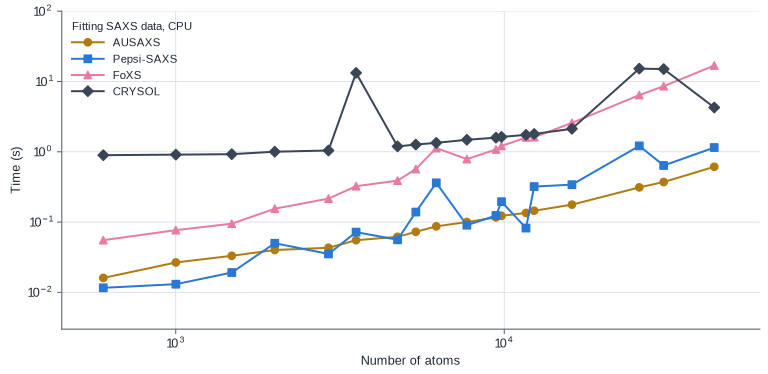
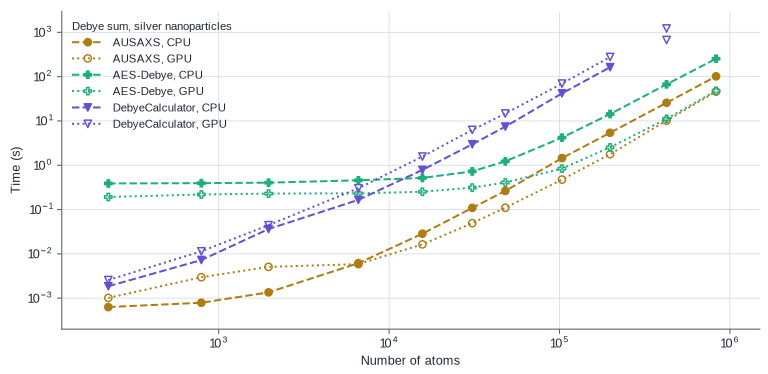
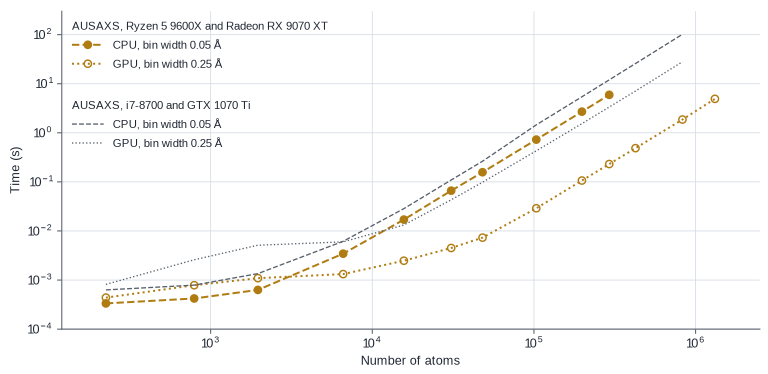
A complete SAXS fit of a typical protein, hydration shell included, takes a few tens of milliseconds on a desktop CPU. In about 10 seconds, a good consumer CPU handles 300 000 atoms, and a high-end GPU with the optional GPU driver a million. This makes it practical to fit thousands of models, such as the frames of a molecular dynamics trajectory, or to run long rigid-body refinements.
How the timings were measured
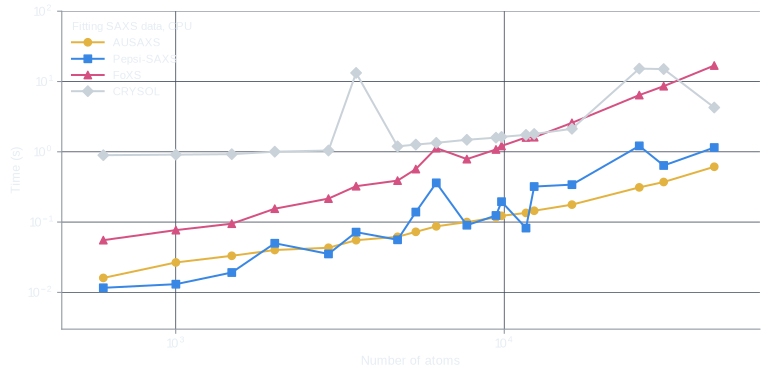
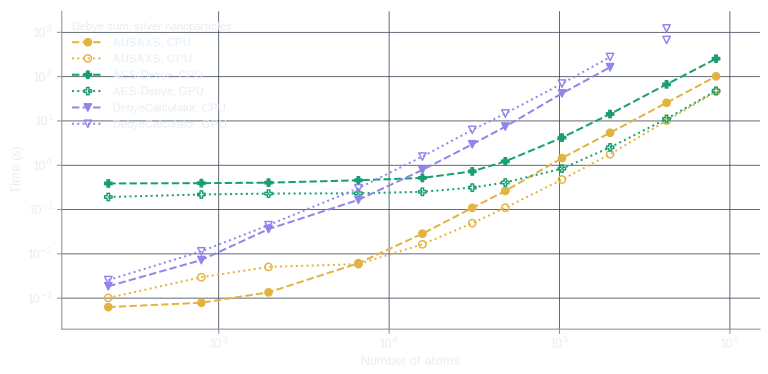
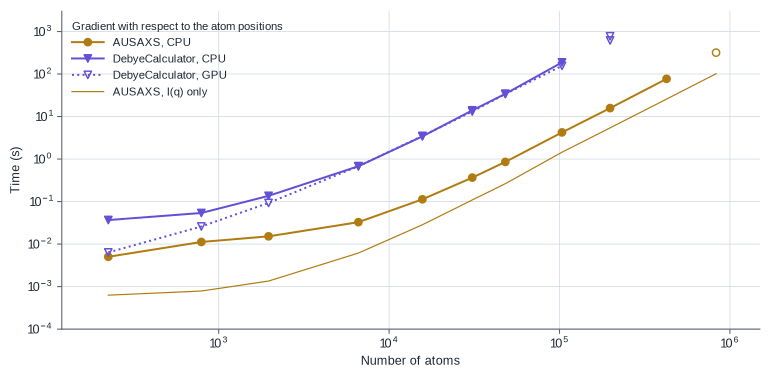
Unless noted, timed on a 2017 desktop: an Intel Core i7-8700 (6 cores) and an NVIDIA GeForce GTX 1070 Ti. Each point is the mean of five runs.
- Fitting SAXS data: a full fit of each structure to its SASBDB data, including reading the files and generating the hydration shell, run from the command line with each program's default settings.
- Debye sum: the scattering of spherical silver nanoparticles in vacuum, from the atomic coordinates in memory to I(q) at 1000 points up to q = 10 Å⁻¹. AUSAXS used a bin width of 0.05 Å. An open marker without a line is a single run over the 300-second time limit.
- Modern hardware: AUSAXS alone on a current desktop, an AMD Ryzen 5 9600X (6 cores) and an AMD Radeon RX 9070 XT, with the 2017 desktop in grey. The GPU is shown at a bin width of 0.25 Å. Smaller bin widths may be considerably slower on the GPU for large particles; this is being worked on.
- Versions: Pepsi-SAXS 2020-07-28, FoXS from IMP (develop branch, 11a86f9), CRYSOL from ATSAS 3.2.1, DebyeCalculator 1.1.1 and AES-Debye 1.0.0.
The exact gradient of the Debye sum of point scatterers with respect to the atom positions is also available (Molecule.debye_raw_vjp in Python), for example as a loss in machine learning:
Accuracy
Thanks to its weighted bins (Lytje & Pedersen, 2025), AUSAXS is accurate over a wide range of angles. For SAS, the reference is the exact vacuum profile of the structure, without hydration shell or excluded volume, as these are modelled differently by every program and have no exact solution.
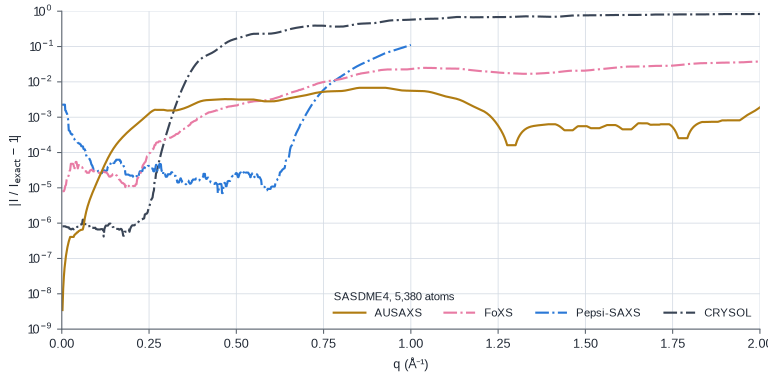
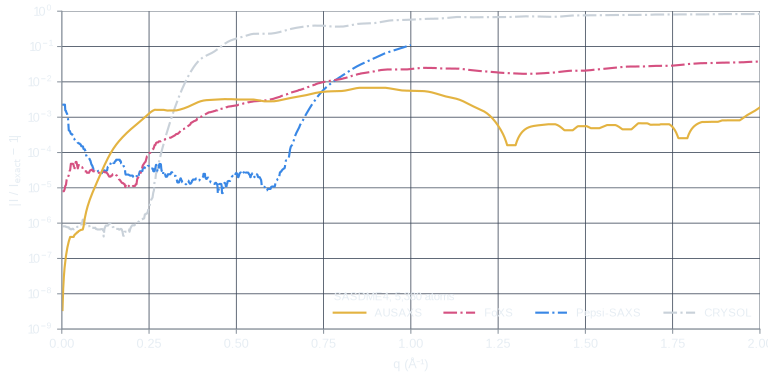
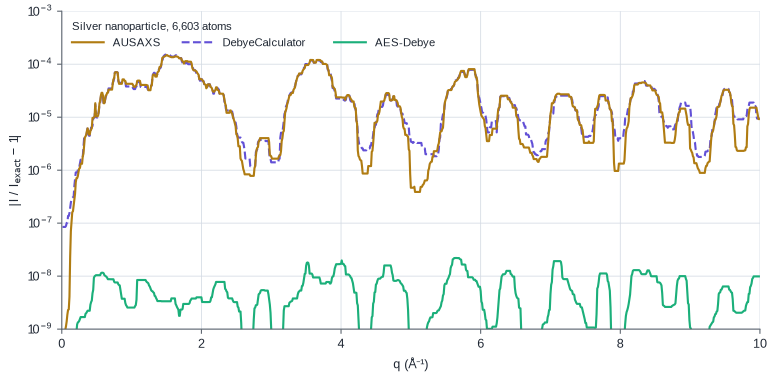
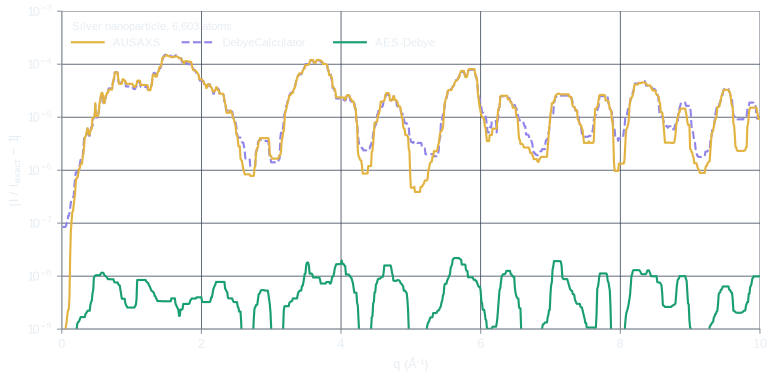
Beyond a certain point, more accuracy gains nothing: rounding the coordinates to the 0.001 Å of a PDB file already changes I(q) by 10⁻³, and measured SAS data are far less certain still.
How the accuracy was measured
- Reference: the exact Debye sum in double precision, computed separately from every program.
- Small angles: the vacuum profile of the protein of SASBDB entry SASDME4 from each SAS program, at its default settings, except that the q range is extended to the program's maximum. As every atom is given the same element, dividing by the profile of a single atom from the same program removes its form factor. AUSAXS uses its default bin width for SAS, 0.25 Å.
- Wide angles: the silver nanoparticle of the speed benchmark. AUSAXS uses a bin width of 0.05 Å.
- The curves are running medians over 0.05 Å⁻¹ (small angles) and 0.25 Å⁻¹ (wide angles), as the deviation spikes at the minima of I(q).
Transparency
A fitted profile is only as trustworthy as its assumptions, so AUSAXS tells you what it did, assumed and fitted:
- Every step and assumption is reported, such as added implicit hydrogens or a guessed q unit.
- Unknown input stops the run instead of being silently guessed; you can override this explicitly.
- Three fit parameters by default (scaling, background, hydration shell), all reported with uncertainties, \(\chi^2\) and convergence.
- The model can be inspected: the structure with its hydration shell is written out, and the profile is split into atom and hydration contributions.
- Settings can be saved, edited and reused.
And it is open source, so anything else can be checked in the code.
One engine, many applications
The same calculation drives SAXS, SANS, rigid-body refinement, EM map validation, crystals and nanoparticles and powder diffraction. It runs on Linux, macOS and Windows, from the command line, Python or a graphical interface, and installs with a single command.