Small-angle X-ray scattering (SAXS)
AUSAXS calculates the SAXS profile of a protein or other biomolecule directly from its atomic model, and fits it to measured data.
What goes into the profile
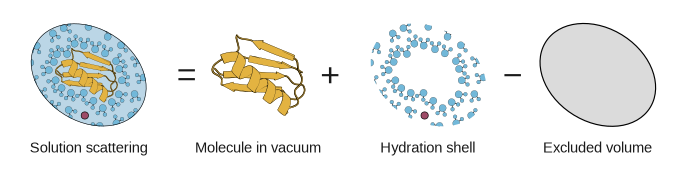
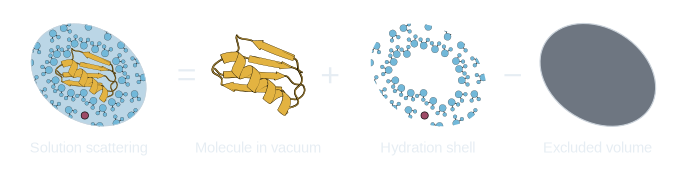
- The atoms in vacuum. Every atom scatters with its own vacuum X-ray form factor. Missing hydrogens are added implicitly to the atoms that carry them.
- The excluded volume. SAS only observes variations in density. The average buffer density is therefore subtracted.
- The hydration shell. A layer of structured water molecules is placed around the surface of the molecule.
For a deeper understanding of the physics, see e.g. Lytje, Pedersen & Hub (2026).
Example
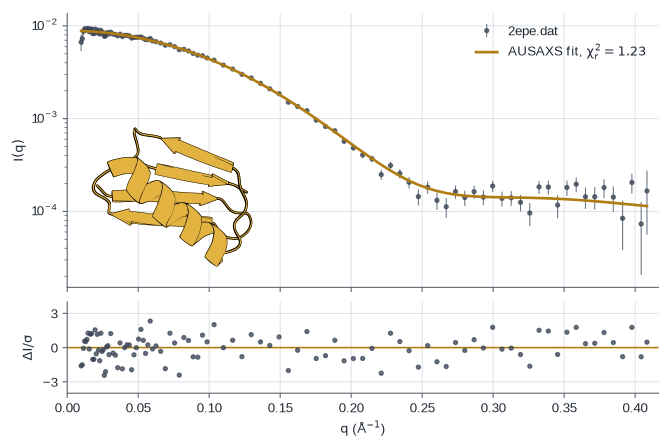
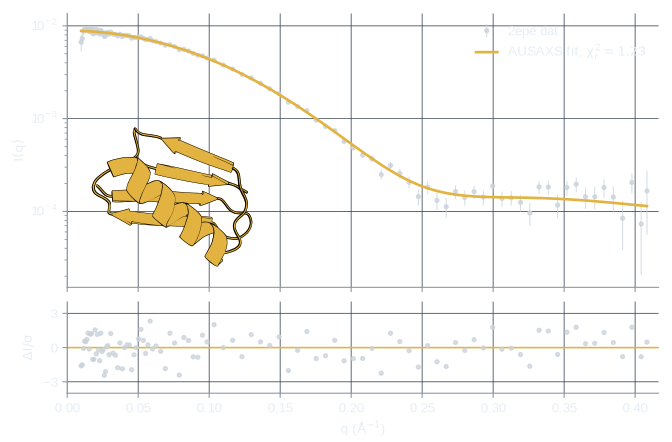
Here we fit the structure of hen egg-white lysozyme, 2epe.pdb, to a SAXS measurement of it, 2epe.dat, and plot the result:
ausaxs saxs 2epe.pdb 2epe.dat
ausaxs plot --folder output/saxs/2epe
import pyausaxs as ausaxs
import matplotlib.pyplot as plt
mol = ausaxs.create_molecule("2epe.pdb")
mol.hydrate()
result = mol.fit("2epe.dat")
result.plot()
plt.show()
For a worked example on real data, see the proteins tutorial. Every option of ausaxs saxs is listed in its documentation.