Crystals and nanoparticles
AUSAXS calculates the scattering of crystals, nanoparticles and any other collection of atoms with the Debye equation, using the vacuum form factor of every atom.
The Debye equation describes a sample of randomly oriented particles. A crystal therefore gives no Bragg spots, since every reflection is spread over all orientations. Instead, each set of lattice planes with spacing \(d\) shows up as a peak at \(q = 2\pi/d\) in the profile.
Example
Here we calculate the scattering of a silver nanoparticle of 201 atoms, about 2 nm across, Ag_crystal.cif, up to \(q = 10\) Å⁻¹:
ausaxs debye Ag_crystal.cif --qmax 10
import numpy as np
import pyausaxs as ausaxs
import matplotlib.pyplot as plt
ausaxs.settings.histogram(bin_width=0.05)
q = np.linspace(0.01, 10, 2000)
mol = ausaxs.create_molecule("Ag_crystal.cif")
_, I = mol.debye_raw(q, form_factors=True)
plt.semilogy(q, I)
plt.xlabel("q [Å⁻¹]")
plt.ylabel("I(q)")
plt.show()
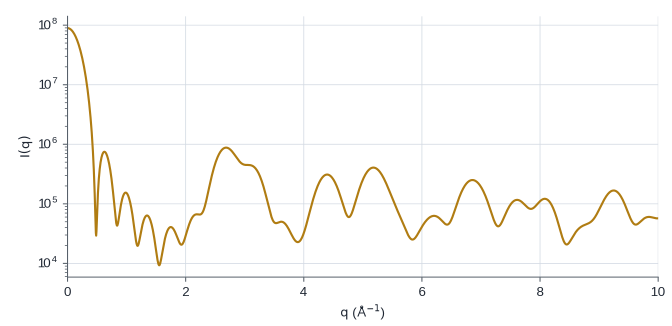
For a worked example in Python, see the crystal scattering example. Every option of ausaxs debye is listed in its documentation.