Small-angle neutron scattering (SANS)
Warning
SANS support is a new feature and still in active development. It works, but the fit parameters occasionally fail to converge. If you run into convergence problems or any other errors, please open an issue so we can fix them.
AUSAXS calculates the SANS profile of a protein or other biomolecule directly from its atomic model, and fits it to measured data. It uses the same pipeline as for SAXS; only the scattering of the atoms and the solvent changes.
What changes for neutrons
- The atoms. Every nucleus scatters as a point with a constant scattering length. Hydrogen scatters about half as strongly as carbon, and with the opposite sign. Hydrogens (and deuterons) therefore matter far more than in SAXS, and should be modelled explicitly whenever possible.
- The solvent. The solvent is usually a mixture of H₂O and D₂O, and its composition sets both the scattering of the bulk solvent and the contrast of the hydration shell. It also reaches into the molecule, as solvent-exposed hydrogens can exchange with deuterons and affect their scattering lengths.
For a deeper understanding of the physics, see e.g. Lytje, Pedersen & Hub (2026).
Example
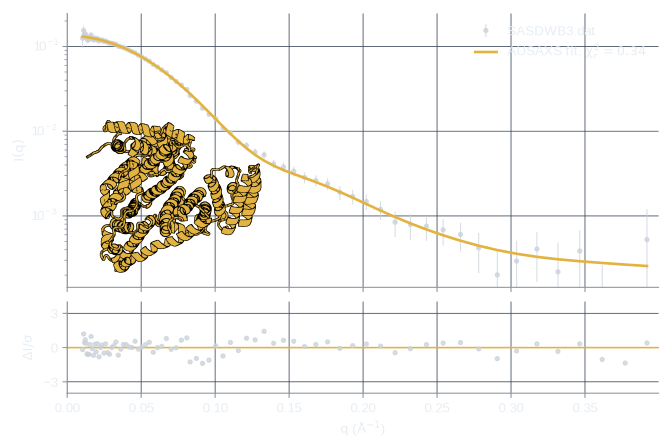
Here we fit the structure of bovine serum albumin, 4f5s.pdb, to a SANS measurement of it in 100% D₂O, SASDWB3.dat, keeping the explicit hydrogens of the structure, and plot the result:
ausaxs sans 4f5s.pdb SASDWB3.dat hydrogens --keep
ausaxs plot --folder output/sans/SASDWB3
import pyausaxs as ausaxs
import matplotlib.pyplot as plt
ausaxs.settings.set("radiation", "neutron")
ausaxs.settings.set("keep_hydrogens", "true")
mol = ausaxs.create_molecule("4f5s.pdb")
mol.hydrate()
result = mol.fit("SASDWB3.dat")
result.plot()
plt.show()
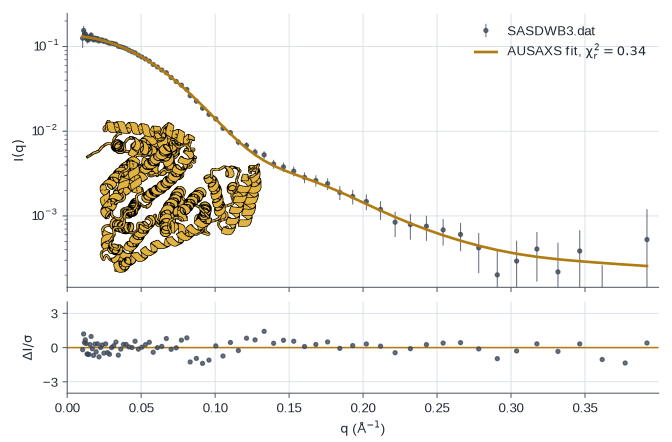
For a measurement in another H₂O/D₂O mixture, pass its D₂O fraction with solv --d2o, e.g. solv --d2o 0.42; the default is 1, pure D₂O. Every option of ausaxs sans, including the composition of the solvent, is listed in its documentation.